Web designing in a powerful way of just not an only professions. We have tendency to believe the idea that smart looking .

Retail Management Software That Brings Your Entire Store Together

Retail businesses today need more than basic billing. They need accurate inventory, faster checkout, reliable sales information, customer visibility, purchase control, and actionable reports from one connected system. Retail management software helps businesses bring these everyday operations together so owners and teams can work with greater speed, accuracy, and control.

PAIT BIZ Systems Pvt. Ltd. provides retail-focused technology solutions designed to simplify store operations and support businesses as they grow. From POS billing and inventory management to reporting, customer management, integrations, and customized workflows, the right retail technology can reduce repetitive manual work while giving business owners a clearer view of what is happening across their stores.

retail management software

What Is Retail Management Software and Why Does It Matter?

Retail management software is a centralized business solution that helps retailers manage core activities such as billing, sales, inventory, purchasing, customer information, reporting, and day-to-day store operations. Instead of maintaining separate records across spreadsheets, billing applications, notebooks, and disconnected systems, retailers can manage important information through a structured digital platform.


A modern retail environment generates a large amount of operational data every day. Every sale changes inventory, every purchase affects stock availability, every customer transaction creates useful buying information, and every discount can influence margins. When these activities are managed manually or through disconnected tools, it becomes difficult to maintain accuracy and make timely decisions. Retail management software connects these workflows so information can move more efficiently between different parts of the business.


For Indian retailers, the software can be especially valuable when the business needs GST-ready billing, barcode-based transactions, multiple payment options, inventory visibility, purchase tracking, customer records, and business reports. PAIT’s retail POS solution is designed around efficient transaction management, inventory management, CRM, reporting, integrations, security, and ongoing support.


The bigger advantage is visibility. A store owner should not have to wait until the end of the day to understand sales performance or manually count every product to identify stock issues. A connected system can make operational information easier to access, helping retailers respond faster to changing demand and daily business requirements.


Internal linking opportunities: Link relevant phrases such as retail POS system, customized POS software, best POS software in India, and Smart Pro ERP to their respective PAIT Systems pages. PAIT already offers dedicated retail POS and customized software solutions for industries including apparel, cosmetics, jewellery, grocery and supermarkets, sports equipment, and car accessories.

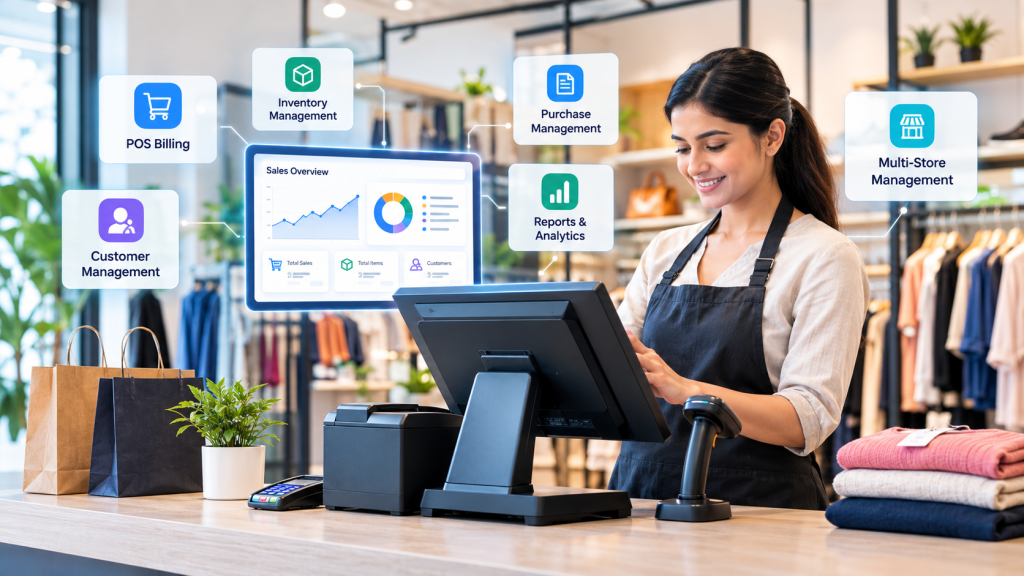
6 Essential Capabilities of Modern Retail Management Software

1. Fast POS Billing and Checkout

A reliable retail system should make checkout quick, accurate, and easy for staff. Barcode scanning, automated calculations, digital payments, discounts, invoice generation, and organized transaction processing can reduce manual billing work and improve the customer experience.

2. Real-Time Inventory Visibility

Inventory accuracy directly affects sales and customer satisfaction. A connected system can help retailers monitor available stock, identify fast-moving products, reduce unnecessary overstocking, and make replenishment decisions using current inventory information.

3. Purchase and Supplier Management

Retailers need control over what they purchase, from whom they purchase it, and when new stock is expected. Purchase records, supplier information, stock receiving, and product-level purchase history can create a more organized procurement process.

4. Customer Management and Purchase History

Customer data becomes more valuable when it is organized and connected with transactions. Retailers can maintain customer profiles, understand purchase patterns, improve service, and create more relevant engagement strategies based on available business information.

5. Sales Reports and Business Analytics

Reports turn everyday transactions into useful business intelligence. Retail owners can review sales performance, product movement, transaction trends, and other operational information to identify opportunities and make decisions based on data rather than assumptions.

6. Multi-Store and Centralized Management

Growing retailers need visibility beyond one billing counter. A centralized retail system can help businesses manage multiple locations, monitor store-level activity, maintain organized inventory records, and review consolidated business information from a more controlled environment.


How Retail Management Software Improves Everyday Retail Performance

The real value of retail management software is not simply having more features. Its value comes from connecting the activities that employees and business owners perform every day. When billing, stock, customer records, purchases, and reports are handled through a coordinated system, employees spend less time switching between different records and more time serving customers.


Consider a common retail situation. A product is sold at the counter, but the stock record is updated later. Another employee checks an outdated spreadsheet and assumes that the product is available. A customer is then told that stock exists when the actual quantity is already low. These small information gaps can create lost sales, unnecessary work, and customer dissatisfaction.


A connected retail solution helps reduce these operational gaps by keeping important business information organized. When sales and inventory workflows are connected, retailers have a stronger foundation for monitoring stock movement, reviewing product performance, and planning purchases.


The same principle applies to business reporting. Instead of collecting sales figures from different counters and manually preparing reports, management can use centralized information to understand performance more efficiently. Modern retail platforms increasingly focus on creating a single source of operational truth across sales, inventory, customers, and channels.


For businesses with specialized requirements, customization is another important consideration. Apparel retailers may need product variations and size-related inventory management, while jewellery businesses need detailed tracking for valuable products. Supermarkets require efficient management of large product assortments, while electronics and accessory retailers may need product-specific workflows. PAIT’s customized POS approach addresses different industry requirements rather than treating every retail business as identical. This makes the selection of retail software less about choosing the platform with the longest feature list and more about choosing a solution that fits the actual operating model of the business.


PAIT’s retail POS offering focuses on practical business requirements such as transaction processing, inventory management, CRM, reporting, integrations, security, and support. This combination is particularly relevant for small and growing retailers that want to bring several operational activities into one system. Another important advantage is customization. A grocery store, apparel outlet, jewellery business, and cosmetics retailer do not manage products in exactly the same way. PAIT provides industry-specific POS solutions designed around these different requirements.


PAIT’s website also highlights testimonials from retail businesses describing long-term use, customization, usability, and support. These customer experiences can provide useful context when evaluating the practical side of a retail software provider.

For more information about PAIT’s complete retail technology offering, visit the PAIT Systems homepage.

6 Business Benefits of Choosing the Right Retail Management Software

1. Faster and More Accurate Billing

Automated billing reduces repetitive calculations and helps staff process transactions efficiently. Faster checkout can reduce queues, improve customer convenience, and allow employees to handle more transactions during busy periods.

2. Better Stock Control

Accurate inventory information helps retailers understand what is available, what is moving quickly, and where attention may be required. Better stock visibility can support purchasing decisions and reduce avoidable inventory problems.

3. Improved Decision-Making

Retail owners need timely information to make practical decisions. Sales reports, product performance data, and operational analytics provide a stronger foundation for deciding what to purchase, promote, discontinue, or monitor.

4. Reduced Manual Work

Retail operations often involve repetitive data entry, calculations, record maintenance, and report preparation. Automation can reduce unnecessary administrative work and allow employees to focus more on customers and productive store activities.

5. Better Customer Experience

Customers expect accurate billing, faster service, convenient payment options, and product availability. A well-designed retail system supports these expectations by helping employees access relevant transaction and product information quickly.

6. Scalable Retail Operations

A software solution should support the business beyond its current size. Whether a retailer operates one store or plans to expand into additional locations, scalable systems can provide a more structured foundation for future operational growth.


why PAIT Systems Is a Strong Choice for Retail Technology

Choosing retail software is a long-term operational decision. The platform should be practical for employees, useful for management, adaptable to business requirements, and supported after implementation. PAIT BIZ Systems Pvt. Ltd. has a long-standing focus on retail and inventory management solutions, with its business history tracing back to 2004 under Numeron Systems and later evolving through LNB InfoTech before becoming PAIT BIZ Systems.


PAIT’s retail POS offering combines transaction management with inventory, customer relationship management, reporting, integration capabilities, security, and implementation support. This broader approach is important because retail operations rarely depend on billing alone. Sales, stock, customer information, reporting, hardware, and supporting systems need to work together for a business to operate efficiently.


Another advantage is customization. PAIT provides solutions for different retail segments, including apparel, cosmetics, jewellery, grocery and supermarkets, sports equipment, and car accessories. This industry-oriented approach can be valuable for retailers whose workflows cannot be effectively handled by a generic billing application. PAIT also combines software capabilities with technology support, which can be important during implementation and day-to-day usage. The company states that it provides installation, training, support, and integration capabilities for its retail POS solution.


For retailers evaluating technology, the objective should therefore be clear: choose a platform that simplifies current operations while creating a reliable foundation for future growth.

Frequently Asked Questions?

1. What is retail management software?

Retail management software is a digital system that helps retailers manage billing, sales, inventory, purchasing, customer information, reporting, and other daily store operations through a connected platform.

Yes. POS software primarily focuses on billing and transaction processing, while retail management software generally covers a wider range of operations such as inventory, purchasing, customer management, reporting, and multi-store activities.

Important features can include POS billing, barcode scanning, inventory management, purchase management, customer records, sales reports, GST-ready invoicing, payment support, user controls, integrations, and multi-store management.

Yes. Small retailers can use it to reduce manual work, organize inventory, speed up billing, maintain sales records, and understand business performance more efficiently without relying heavily on spreadsheets or handwritten records.

The right platform can support multi-store operations by organizing store-level information, inventory, sales, users, and reporting through centralized management. Requirements vary depending on the software and business structure.


Yes. PAIT Systems offers customized POS solutions for different retail industries, including apparel, cosmetics, jewellery, grocery and supermarkets, sports equipment, and car accessories.

Yes. PAIT Systems provides a retail POS solution covering billing, inventory management, CRM, reporting, integrations, transaction security, and support.

Start by identifying your billing process, inventory requirements, number of stores, reporting needs, employee workflows, integrations, customization requirements, support expectations, and future growth plans. Then compare solutions based on how well they fit those real operational needs rather than choosing only by price or feature count.

Reach us on WhatsApp
1